
2016: I get my long second draft to a developmental editor
The first “complete draft” of my novel, provisionally titled Worst Case 2020, feels like it is ready for beta readers. I have been working on it off and on since 2008 National Novel Writers Month. It is almost 500 pages in double-spaced manuscript.
It is written in first person present tense with a dozen narrators: Jaime, Olivia, Jody, Pearl, Staci, Felicity, Laurie, Giles, Frick, Sam, Ed, Sally, Dean and occasionally others. Each section is labeled with speaker and location to help the struggling reader.
I deliver this draft to a highly recommended developmental editor, Annie Pearson, and soon she gives it to me straight: Pick a few major characters to provide the points of view. The rest should be supporting characters.
Second, it’s risky to use first-person present tense throughout.
(Here’s an example: My garden gloves are tossed aside and I have dirt under my fingernails. Hey hey! I’ve picked my first eggplant of the year and four big lumpy tomatoes. Time to head home to my sweetheart. Sam should cowboy up and marry me. We’re 46 and 45 years old for gosh sakes.)
Recommendation: convert to third person past tense, what storytellers generally use.
I paid for that advice and I trusted Annie’s judgment, so the third draft was a lot different. My chosen major characters were Laurie, Giles, and Frick. The others no longer narrated directly, popping up here and there. [Realization: this blog post has shifted from present to past tense. I didn’t plan that. LOL]
That fall I had a seat in a training program for writers, sponsored by the Artists Trust of Washington, LitEDGE 2016. Its purpose was to give writers the knowledge of the business side of their art, and improve their chances of making a living at it. In 10 days at Fort Worden, near Port Townsend, Washington, Nicole Hardy, author of Confessions of a Latter-Day Virgin and other works, was our lead trainer. We had sessions with experts from all aspects of lit marketing: professional editing, agents, small publishers, self-published authors, social media producers, website designers, business managers.
At LitEDGE I made a group of close friends who have supported one another ever since. Much of what I learned in that course still guides my activities.
2017 and 2018: You must find an agent
At LitEDGE, our coaches had presented self-publishing as a viable route to success, and emphasized that successful writers must market their work, whether they find a publisher or take that mantle upon themselves. We learned many methods for building our audience.
I felt strongly that I wanted the legitimacy of a publisher; I didn’t feel prepared to be a marketer.
When I reached what I thought was the final draft, I gave it to a copy editor, and I undertook to find an agent. Long story short, I used an agent-finding app and worked hard at it over the best part of a year. I got form letters back (or crickets).
So I put the book on the shelf and called it a learning experience. Gave it to friends to read from time to time.
2025: Reality has been feeling more and more dystopian
With Donald Trump’s election in 2016, my reaction was, “My novel just got more believable.” Trump’s response to the COVID pandemic was hard to fathom. Recommending ivermectin, discouraging testing because it increased the numbers. Denying reality and undercutting public health directives. But that phase was mild compared to what happened in January 2021, when Trump and associates orchestrated the violent attack on the capitol, trying to stop the certification of Biden’s win.
It was hard for me to fathom how Trump won the election in 2024.
During the campaign I had been working with a small group of friends who called ourselves Momentum Blue Seattle, all 20 of us. We wrote postcards and tried to inform voters about the extreme plans spelled out in Project 2025, the rightwing blueprint for undoing the half-century or more of progress in moving toward “all men are created equal and endowed with certain unalienable rights.” We were disconsolate when Trump got in again.
After the inauguration, with the visual of our American oligarchs lined up in the front row at the ceremony, I told my friends I wanted to take a leave of absence from organizing and self-publish my book, because it was becoming so congruent with current events. Maybe it could contribute to the resistance.
But as the news got worse and worse, I threw myself into our organization’s efforts to publish protest signs and give them away, and keep our spirits up by protesting and supporting one another.
2026: My book must come out
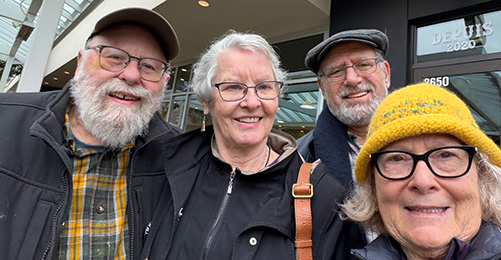
My husband David and I had become close friends with David and Carol T through oldtime music. That’s Carol in the yellow hat in the post’s featured picture. She is important to my story.
We helped start an oldtime music gathering in Seattle. (How come Port Townsend, Olympia and Portland had one and we didn’t?) Carol and I worked various jobs at Old Growth Oldtime the first two years, and the two Davids worked together in my husband’s guitar building and repair shop.
I gave Carol the computer manuscript of what I was now calling: The Palisade Trilogy: Barter. (Note the implication of sequels.) She got back to me:
Finished it. Loved it! It’s a book for all ages. Young reader to adult. It’s a Pulitzer Prize book. American author describing American experiences? Yes?
I replied:
You just made my day. You just made my week!
You just made my month!
You just made my year!!
I am also laughing.
That’s what got me unstuck. I decided to believe Carol and self-publish the thing.
In Part Two of “Going Indie to Publish,” I will relate my experience up to the moment when I held the first paperback copy in my hand.
Leave a Reply